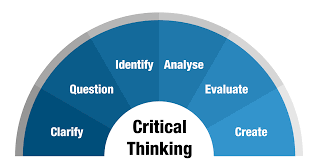
Critical Thinking Definition:
Critical thinking is the disciplined ability to gather, process and evaluate
information before reaching a conclusion or making a decision. It involves questioning
assumptions, comparing different perspectives, recognizing strengths and weaknesses, and
using reliable evidence to develop a reasonable position. Critical thinkers do not simply
accept information, they analyze its meaning, relevance and accuracy. They also clarify
problems, develop effective solutions, execute plans and evaluate the results. In academic and
professional settings, critical thinking supports responsible decision-making,
logical problem-solving, clear communication and the ability to defend conclusions with
convincing evidence.
REFLECTION PARAGRAPH ON 1st ASSIGNMENT:
Assignment Name: “Qualitative Versus Quantitative Research” In-Class Essay Rewrite
Competency: Critical Thinking Course: Critical Thinking and Problem Solving
Indicator 1: Gathers and Processes Information for Decision Making, Indicator 2:
Develops and Reasonably Defends Arguments, Positions and Decisions, Performance
Level: Advanced. In this assignment, I analyzed Basanta Kandel’s article about qualitative
research, quantitative research, and the use of mixed methods. I then wrote a structured
comparison essay during class without using my mobile phone. My essay explained that
qualitative research examines meanings, experiences and behaviors through methods such as
interviews, observations and case studies. In contrast, quantitative research measures
variables using numerical data, controlled procedures and statistical analysis. I also explained
that the two approaches are complementary because combining them can provide both
detailed human insight and measurable evidence.
This assignment strengthened my ability to gather information, identify important
differences, compare evidence and organize ideas before reaching a balanced conclusion. The
main difficulty was processing a large amount of information and deciding which details
were most relevant to the comparison. I also had to avoid irrelevant ideas, inconsistent
structure, grammatical errors and a thesis that was too broad or too narrow. I overcame this
challenge by organizing the information into clear categories, including purpose, data
collection, objectivity, scope, analysis and outcomes. I then used an introduction, two focused
body paragraphs and a conclusion to present the comparison logically. I consider my
performance advanced because I received full marks, accurately explained both research
methods and defended the position that the approaches can work together to create more
comprehensive knowledge. My advice to students completing a similar assignment is to read
the source carefully, identify comparison categories before writing and prepare a brief outline
so that every paragraph directly supports the thesis.
REFLECTION PARAGRAPH ON 2nd ASSIGNMENT:
Assignment Name: “MacBook Advertisement Analysis” Five-Minute Video
Presentation Competency: Critical Thinking Course: Critical Thinking and Problem
Solving, Indicator 2: Develops and Reasonably Defends Arguments, Positions and
Decisions, Indicator 4: Executes Plans and Evaluates Results Effectively, Performance
Level: Advanced. For this assignment, I created a five-minute video for my professor in
which I described the MacBook and explained why I would advertise it. I analyzed the
advertisement’s goals, target audience, persuasive techniques, visual rhetoric, factual
representations and overall effectiveness. The central message, “Powerful. Light.
Limitless,” presents the MacBook as a professional, elegant and reliable product. I explained
that its minimalist design, bright lighting, neutral background, slim aluminum body,
portability, Retina display and processing power support an image of quality, creativity and
productivity.
This assignment developed my ability to move beyond describing an advertisement and
critically examine how and why it persuades consumers. I identified the target audience as
university students, designers, young professionals and other technology-focused users who
value mobility, performance and modern design. I argued that advertising the MacBook is
effective because the product is presented not only as a computer but also as a tool for
success and a symbol of ambition and professionalism. The main challenge was selecting the
most important information and communicating it clearly within the five-minute limit. I
overcame this obstacle by arranging the video around a logical sequence: the advertisement’s
purpose, persuasion methods, audience, product features, emotional appeal and final
evaluation. I consider my performance advanced because I received full marks, completed
the video successfully, supported my evaluation with specific visual and factual evidence,
and clearly defended why the advertisement appeals to its intended audience. My advice to
students is to plan the video before recording, focus on a few strong points, connect every
design feature to its persuasive effect and rehearse with a timer to ensure a clear and
organized presentation.

